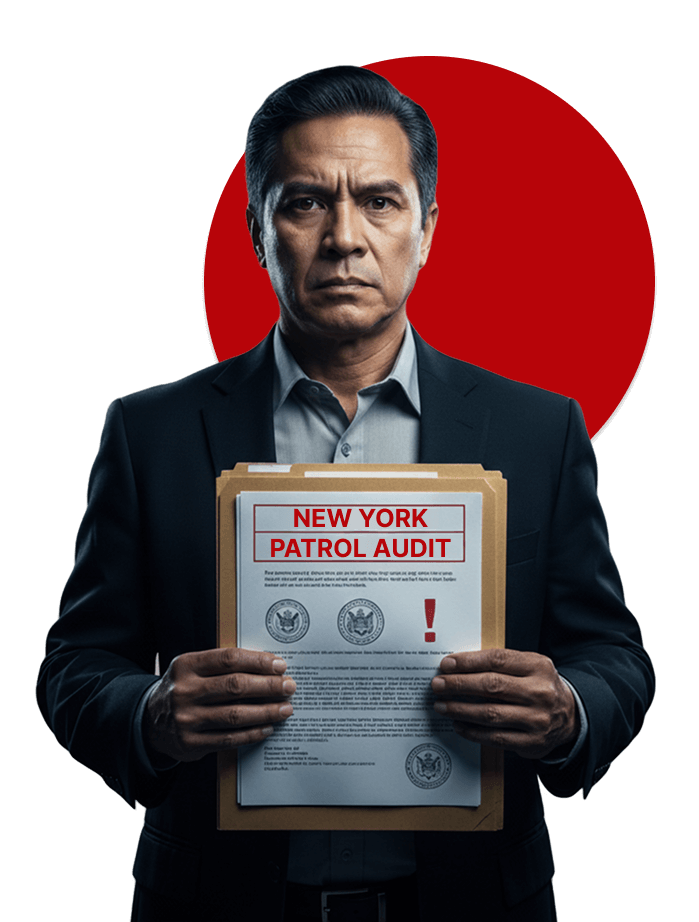









New York State Patrol (Walk-In) Audit Defense

New York State “Patrol” audits are unannounced, aggressive, and fast-moving.

A patrol auditor may walk into your business without warning, question employees, demand records, and begin an inspection immediately.

These audits frequently result in:

Businesses that attempt to handle patrol audits alone often overpay thousands of dollars due to rushed assumptions and missing documentation.

TREA focuses on New York State patrol audit defense, applying structure and control to audits designed to catch businesses off guard.

What Is a Patrol Audit?

A Patrol Audit is a surprise sales tax inspection conducted by New York State field agents.

Unlike scheduled audits, patrol audits are designed to be fast, intense, and disruptive.

Auditors may:

Their objective is to determine whether reported sales align with perceived activity—often based on limited observation.

Common Issues in Patrol Audits

A single misstatement by an employee can trigger a full multi-year sales tax audit.

Industries Targeted Most Frequently

Restaurants and food service businesses

Takeout counters

Retail shops

Bodegas

Grocery and convenience stores

Salons and barbershops

Liquor stores

Small cash-intensive businesses

If your business handles cash or walk-in transactions, it is likely on NYS’s radar.

Why Patrol Audits Often Lead to Overstated Assessments

Assessments are frequently based on:

Incorrect markup formulas Industry averages Suspicious credit-card-to-cash ratios Missing or incomplete documentation NYS estimated assessments Delivery platform reports not reconciled to POS totals Estimated seasonal activity A single day’s observation

Without professional intervention, these assumptions often become the final tax bill.

Why Businesses Choose Our Patrol Audit Defense Process

Former NYS auditor insight into patrol audit methodology

Deep POS reconstruction and delivery-platform reconciliation experience

Ability to challenge inflated assumptions and estimates

Strong documentation and audit-control strategy

Rapid response during live or active audits

Structured, detail-driven advocacy

Many patrol audits can be reduced significantly when defended properly.

Patrol Audit Defense Using the Triple-S Framework

Study → Satisfy → Solve

PHASE 1 - STUDY

(Audit Risk & Exposure Review)

We analyze:

This phase identifies where NYS assumptions are incorrect, overstated, or unsupported.

Not every case proceeds beyond Phase 1.

PHASE 2 - SATISFY

(Compliance & Documentation Preparation)

When required, we:

Proper reconstruction limits exposure and improves negotiating leverage.

PHASE 3 - SOLVE

(Representation & Resolution)

We

The objective is to protect the business and reduce liability, not simply respond.

What Happens If a Patrol Audit Is Ignored?

NYS “Patrol” auditors may enter a business without notice, often targeting:

NYS may issue estimated assessments

Collection actions may begin

Automatic penalties may apply

A broader multi-year audit may be opened

Warrants may be filed

Patrol audits should never be ignored.

Who This Page Is For

How to Get Started

Patrol audits move quickly. The first step is determining whether a full review is appropriate.

Client Stories

Get Clarity Before You Commit

© 2026 All Rights Reserved | Privacy Policy | Terms of Use | Important Disclosures | You may unsubscribe to stop receiving our emails.