If you owe IRS or NYS back taxes but cannot pay in full, you may qualify for an affordable payment plan.
These plans can:
Stop enforced collection
Protect your wages and bank accounts
Prevent or release levies
Reduce pressure while restoring compliance
Allow you to pay over time without additional harassment
As a CPA, CIA, and former NYS auditor, I determine which program you qualify for and negotiate directly with the agency on your behalf.
Common Problems in NYS Sales Tax Audits
Types of IRS Payment Plans
Streamlined Installment Agreement (Most Common)
Available for balances up to $50,000 ($25,000 for businesses)
No financial disclosures required in most cases
Terms up to 72 months
Fast approval when compliant with filing requirements
Non-Streamlined Agreement
For balances over $50,000, requiring full financial disclosure:
Form 433-A or 433-F
Review of income, expenses, assets, & liabilities
IRS may challenge certain expenses
Negotiation is critical
Partial Pay Installment Agreement (PPIA)
A powerful option when:
You cannot afford a standard payment
Paying in full is not possible
The collection statute (CSED) is approaching expiration
Many taxpayers end up paying less than what they owe under a PPIA.
Currently Not Collectible (CNC) / Hardship Status
If your financial situation prevents you from paying anything, the
IRS may:
Pause all collections
Report the account as uncollectible
Leave the debt active but unenforced
Refrain from levies or garnishment
A periodic review applies, but relief is immediate.
Types of NYS Payment Plans
NYS PIPA (Personal Income Payment
Agreement)
NYS evaluates:
Income
Household size
Essential expenses
Assets
Prior compliance
Payment plans can be negotiated for:
Sales tax
Payroll tax
Income tax
Estimated assessments
NYS Hardship Relief
In some cases, NYS may allow temporary reduction or suspension of
payments.
Driver License Suspension Relief
If your NYS license is under suspension threat due to tax debt, we can
negotiate reinstatement through PIPA.
When you’re facing IRS or New York State tax problems, it can feel overwhelming.
You may be dealing with:
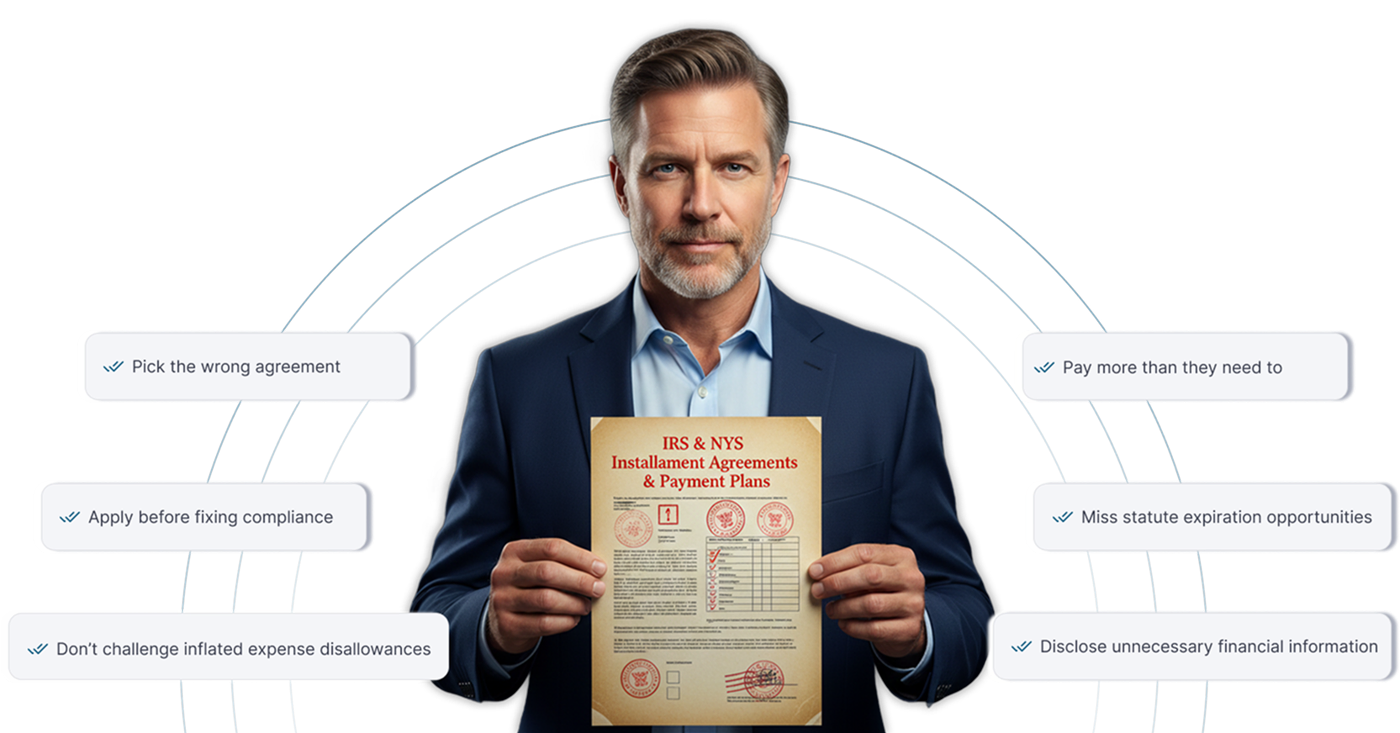
Pay more than they need to
Apply before fixing compliance
Don’t challenge inflated expense disallowances
Disclose unnecessary financial information
Miss statute expiration opportunities
Pick the wrong agreementApply before fixing complianceDon’t challenge inflated expense disallowancesPay more than they need toNYS estimated assessmentsDisclose unnecessary financial informationMiss statute expiration opportunitiesPick the wrong agreement
Pick the wrong agreement
Correct strategy can save thousands.
This is why professional negotiation matters.
Why Clients Choose Our Audit Representation Process
Former NYS auditor
Accurate calculation of allowable expenses
Expert financial analysis for IRS/NYS acceptance
Protection from IRS/NYS contact
Deep experience with hardship & PPIA cases
Our Triple-S Resolution Framework
PHASE 1 - STUDY
(Financial Eligibility & Transcript Review)
We determinee:
Total debt
Statute of limitations (CSED)
Prior agreements
Income & expense eligibility
Whether PPIA or CNC is viable
PHASE 2- SATISFY
With Compliance
Before negotiating:
All returns must be filed
Incorrect returns may need correction
Payroll/sales tax issues must be addressed
Withholding/estimated payments must be aligned
Compliance creates leverage for a lower payment.
PHASE 3 - SOLVE
(Negotiation & Finalization)
We complete:
Full financial analysis
Form 433-A/F if required
Direct negotiation with IRS or NYS
Written confirmation of the agreement
Monitoring for correct implementation
Common Questions
Can an installment agreement be changed later?
Yes — financial changes allow for renegotiation.
Will IRS/NYS stop levies once the agreement is approved?